Documentary script template, ready to turn into a film
The form below starts with a finished 60-second script.
A 60-second example, with timecodes and pictures
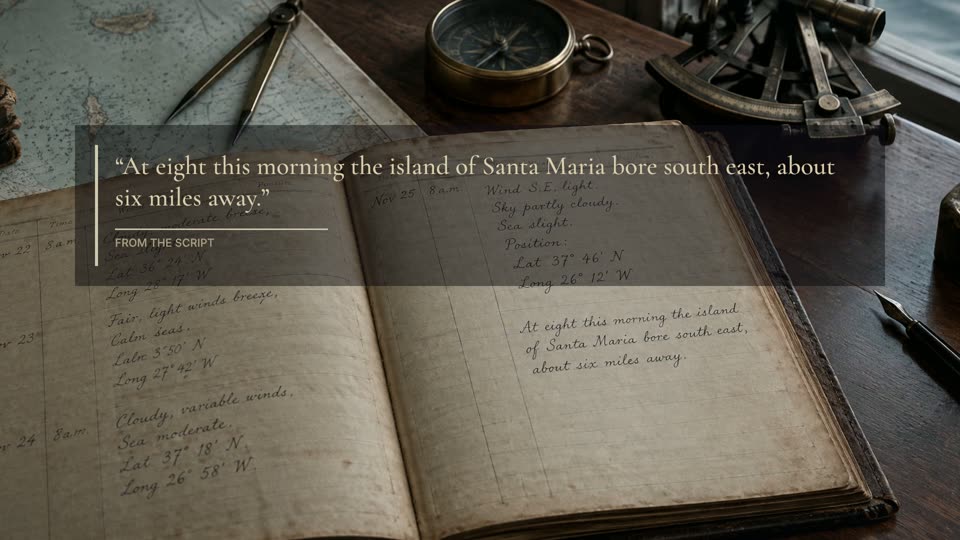 Real sample · Documentary
The script in the form above, 89 words. Timecodes come from the same pace table.
| Time | Narration | Picture |
|---|---|---|
| 0:00 | In December 1872, a ship was found drifting in the Atlantic with her sails set, her cargo untouched and nobody aboard. | A ship under full sail on a calm sea, seen from far off. |
| 0:13 | Her name was the Mary Celeste, and the crew that found her climbed on board expecting to find survivors. | The ship’s deck, empty, ropes trailing in the water. |
| 0:21 | What they found was a logbook, its last entry written ten days earlier, and a ship that looked as if everyone had stepped out for a moment. | An open logbook on a captain’s desk, the last entry visible. |
| 0:31 | The lifeboat was gone. Nothing else was. And for a hundred and fifty years, no one has been able to say why. | A rowing boat missing from its davits. |
Four fill-in documentary scripts
Each one has a hook, three acts and a picture cue after each paragraph. Fill the [brackets], delete the [VISUAL] lines, then paste the script into the form above.
History · A period, a place or a person, told in order.
[HOOK: one surprising fact about [TOPIC], in one sentence.]
[VISUAL: the place as it looked in [YEAR], wide and still.]

In [YEAR], [PLACE] looked nothing like it does today. [Two sentences on who lived there and what an ordinary day was like.]
[VISUAL: a street or room, one person at work.]

Then [EVENT] changed it. [Two sentences: what happened, and who first noticed.]
[VISUAL: the moment, in close view.]

[Two or three sentences on what people did next, and what it cost them.]
[VISUAL: the same place a year later.]

Today, [one sentence on what is left]. And that is why [TOPIC] still matters.
True crime · A case told from the first fact to the open question.
[HOOK: the one detail that made the case strange, in one sentence.]
[VISUAL: the scene on the first morning, wide.]

On [DATE], [PERSON or PLACE] was [FOUND / MISSING / ABANDONED]. [Two sentences on the first facts. Only what the record shows.]
[VISUAL: a document, a map or a timeline on a table.]

The first theory was [THEORY]. It fit [FACT ONE]. It did not fit [FACT TWO].
[VISUAL: two items from the file, side by side.]

[Two sentences on the second theory, and who proposed it.]
[VISUAL: a person at a desk with papers.]

[One sentence on what is still unknown.] [One sentence on what the record does settle.]
Science · One question, one answer, one thing that surprised the researchers.
[HOOK: the question, as a viewer would ask it.]
[VISUAL: the everyday thing the question is about.]

For a long time, the usual answer was [OLD ANSWER]. [One sentence on why it seemed right.]
[VISUAL: a simple diagram of the old idea.]

Then [WHO] measured [WHAT], and the number was [NUMBER]. [One sentence on why that was a problem.]
[VISUAL: the experiment, close view.]

The explanation turned out to be [NEW ANSWER]. [Two sentences in plain words, with one comparison.]
[VISUAL: the same diagram, redrawn.]

[One sentence: what this changes for an ordinary person.]
Sleep story · Slow, calm, no surprises: a night in one place, told gently.
[HOOK: set the scene in one soft sentence: the weather, the hour, the place.]
[VISUAL: the window or the lane, evening light.]

It is [SEASON], and the year is [YEAR]. [Two slow sentences on the room and what is in it.]
[VISUAL: the hearth, the lamp or the table.]

[Three sentences on one small task: a meal, a letter, mending a coat. No conflict.]
[VISUAL: hands at work.]

[Two sentences on the sounds outside.] [One sentence on the last light going out.]
[VISUAL: the same window, dark.]
How to write the opening, the three acts and the picture cues
- Hook: the one surprising fact, in one sentence, before any background.
- Act one: the place and the people, in concrete nouns and dates.
- Act two: the turn, then the evidence in the order it was found.
- Act three: what is settled, what is still unknown, and a last line that answers the hook.
- [VISUAL] cues: a note to yourself after each paragraph. Longformly picks each picture from the words of the sentence, so a cue is a check that your sentence names something a viewer can see.
What we measured: script words to finished minutes
From the pace table the form uses for the same estimate. Counts are script words, including the 6-second lead-in and the pauses between sentences and paragraphs.
| Film length | History, true crime, science | Space |
|---|---|---|
| 3 min | 459 words | 465 words |
| 5 min | 775 words | 786 words |
| 10 min | 1,565 words | 1,587 words |
| 15 min | 2,356 words | 2,389 words |
| 20 min | 3,147 words | 3,191 words |
| 30 min | 4,728 words | 4,795 words |
| 45 min | 7,100 words | 7,200 words |
| 60 min | 9,471 words | 9,605 words |
Delivered films, 30 October to 12 November 2026
| Measure | Result |
|---|---|
| Topic and length in, 17 films | Finished length divided by the length asked for: median 1.05, 11 of 17 within 10%, range 0.74 to 1.33 (one 5-minute test film is left out: it was run on a 60-minute project) |
| Pasted script, space, 1,271 words | 7.81 minutes finished, 163 words per finished minute (the table above predicts 8.48, 9% long) |
| Pasted script, true crime, 1,285 words | 7.78 minutes finished, 165 words per finished minute (the table above predicts 8.92, 15% long) |
Method (n=19 delivered full films, from 30 October to 12 November 2026): every one in our database since launch, 17 made from a topic and a length and 2 from a pasted script. All are our own test runs, none is customer content. Finished length is the length of the delivered file. The pasted-script sample is two films, so read the table above as a plan, within about 15%, not a promise.
Questions
How long should a documentary script be?
Count about 157 words for each finished minute of narration, and the table above gives the exact figure for 5 to 60 minutes. A 10-minute documentary is about 1565 words. Write to the word count first, then check the length with the form: it shows the estimated minutes as you paste.
How do I start a documentary script?
Open with the single most surprising fact in the story, in one sentence, before any background. Then give the setting, then the turn, then what is still unknown. That is the three-act shape each template follows. Viewers decide quickly whether to stay, so the hook should be the line you would tell a friend first.
What does a [VISUAL] line mean, and do I paste it?
It is a note to yourself about what the viewer should see while a paragraph is spoken. Delete these lines before you paste the script into the form, or the narrator would read them aloud. Longformly does not need them: it picks a picture for each sentence from the words in it, so the way to control the pictures is to write concrete nouns, places and dates.
Does this work for a video essay script?
Yes. A video essay follows the same structure: a hook, a claim, the evidence in order, and a closing line that answers the hook. Use the science template for an argument built on evidence, and the history template for one built on a timeline.
Is the template free to use?
Yes. Copy a template, fill the brackets and make it your own. The free preview of up to 30 seconds also costs nothing and needs no card, so you can hear and see your own script before deciding on the full film.
How we wrote this: the Longformly team, 12 November 2026, from our own pace table and the scripts behind our sample films. See also history for sleep videos, space documentaries and faceless YouTube channel ideas.